
Dirt Town Machines: Every Vehicle and What It Does
Every Dirt Town machine explained: wheel loader, hauler, dozer and excavator, their in-cab ranges, the attachments they share, and the bonus dirt bikes.
Dirt Town launches with four working machines — wheel loader, hauler, dozer and excavator — plus bonus vehicles that start with dirt bikes. Each one covers a different stage of the earthmoving loop, and the in-cab panels expose the same underlying systems: numbered gear ranges with a live speed readout, machine-specific toggles, and a hook system for attachments. If you are deciding what to buy rather than what to drive, the best machines buying order→ is the page you want.
- Wheel loader — the loading stage, and the machine that mounts the most attachments.
- Hauler — the transport stage, with a tipping bed and four ranges.
- Dozer — access and grading, with float, auto-level and offset controls.
- Excavator — digging at depth, breaking rock, and precise trench work.
Wheel loader
The loader is the machine you will spend the most time in during the early game. Its cab panel shows a four-range transmission with a maximum of 14.0 m/s, a hook toggle, and a pick action for the bucket or forks. In practice you use range 1 to 2 for filling the bucket — creeping into a pile gives you a full bucket instead of a spin — and range 4 for the empty run back.
The loader's real value is versatility. It mounts attachments through the hook system, so the same cab can carry forks, a bucket, or specialised tools without buying another vehicle. That is also why the loader is worth its own page: bucket angle and approach speed are where most of your throughput comes from.
Hauler
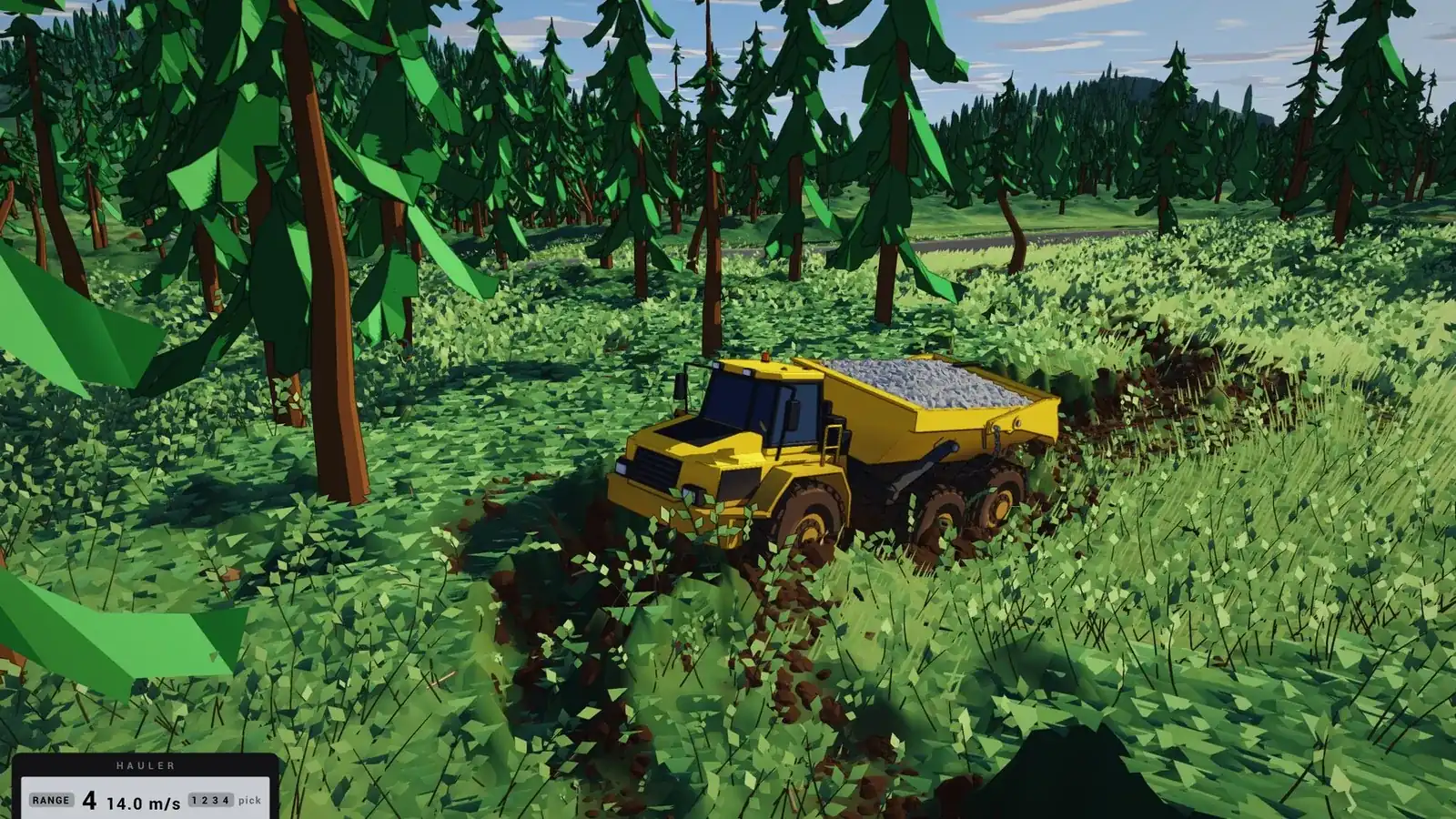
The hauler is a dump truck with four ranges, the same 14.0 m/s top speed as the loader, and a work-light toggle. It carries the material the loader puts in it and tips it at the pad. Two numbers matter more than the top speed: how much it can climb loaded, and how quickly it can tip and clear the pad.
Because the hauler is the heaviest thing on your road, it is also the machine that finds every weak spot in your construction. If a haul route survives a loaded hauler in the wet, it is a finished road. If it does not, the hauler guide→ covers the recovery — and the road work that prevents it.
The demo build shipped the hauler with a work light and four ranges, but Early Access balance and machine interiors can change. The in-cab panel is always the current source of truth.
Dozer
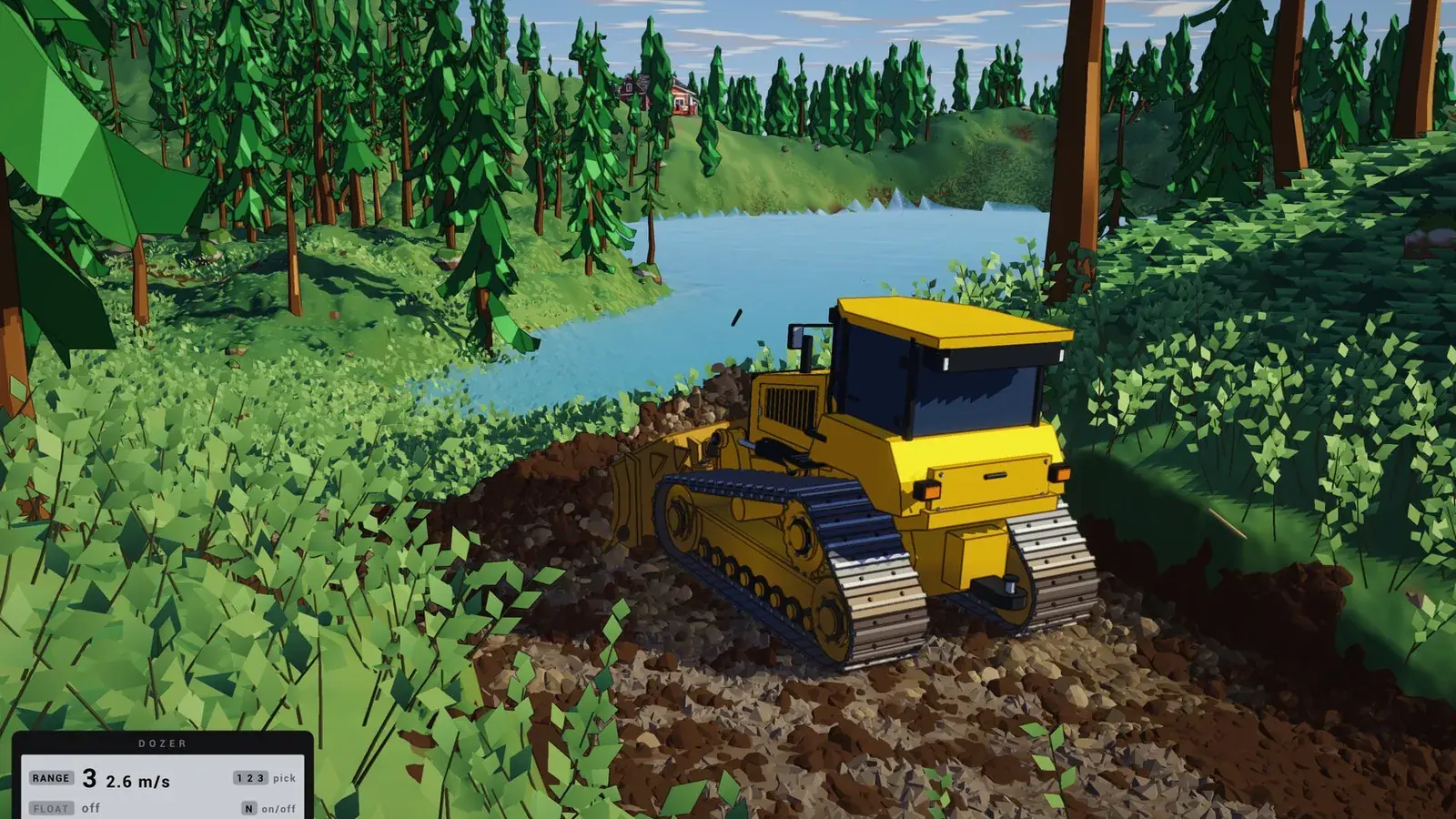
The dozer has three ranges, with the panel showing 1.8 m/s in range 2 and 2.6 m/s in range 3, plus three toggles that do most of the work: float, which lets the blade follow the ground instead of cutting into it; auto, which holds a set slope or curve; and mode with an offset for shifting the blade angle in increments.
Those controls are what make the dozer a grading tool rather than a bulldozing tool. Float for finishing a surface you already cut, auto for holding a long grade while you watch the edges, and offset for cutting a drainage fall across the road without re-aiming the machine. The dozer guide→ walks the sequence.
Excavator
The excavator is the only machine that digs below the surface plane without driving into the hole. It breaks hard material, loads directly into a bed, and — with the hook system — can rig a rock and drag it. On the launch map it is the tool for clay faces, rock seams and drainage trenches.
It is also the slowest machine to move. Tracked and heavy, it should be relocated once per job, not once per load. The operating pattern that works: park it at the face with the spoil side clear, dig a bench you can stand the truck on, and let the hauler come to the machine instead of dragging the machine around the map.
Attachments and bonus vehicles
The hook system is the part of the roster that gets undersold. Attachments hang off a shared mounting standard, and the store page lists a set of tools that includes digging, grading and compacting equipment. The attachments guide→ explains which ones change your hours per tonne and which are just fun.
Bonus vehicles start with dirt bikes. They are not load-bearing machines — they are for getting across the map quickly and for the side mission that asks you to build a track and race, covered in the dirt bike track guide→.
Before you buy anything, sit in each machine for five minutes on flat ground. Knowing which way the boom swings and how fast the blade drops saves more money than any spec sheet.
Machine-by-machine numbers
| Machine | Ranges | Top speed shown | Signature toggles |
|---|---|---|---|
| Wheel loader | 4 | 14.0 m/s | Hook, pick |
| Hauler | 4 | 14.0 m/s | Work light |
| Dozer | 3 | 2.6 m/s | Float, auto, mode, offset |
| Excavator | In-cab panel | Not published | Attachment hook |
Speeds are the values printed on the in-cab panels in the official store screenshots. They tell you what the game considers normal working speed, not what the fastest machine is: the dozer is deliberately the slowest, because you are meant to be measuring ground, not covering it.
Official source: Dirt Town store page ↗ — machine list, cab HUD and attachment system. Community source: Dirt Town discussions on Steam ↗ — owner reports on machine behaviour as the build changes.
FAQ
How many machines are in Dirt Town at Early Access launch? Four working machines — wheel loader, hauler, dozer and excavator — plus bonus vehicles such as dirt bikes. Skyturns describes the launch map as medium sized for mining and road building.
Can you swap attachments on any machine? Attachments use a shared hook system, but not every tool fits every machine. The loader is the most flexible; the excavator and dozer have their own tool sets.
Is there a fifth machine planned? The Early Access FAQ promises "more machines" in the full version without naming them. Snow, forestry and more mining are the directions the developer has talked about.