
Dirt Town Dozer Guide: Grading, Float and Auto-Level
How to grade with the Dirt Town dozer: cut in layers, hold grade with auto, finish in float, cut cross-fall with blade offset, and build climbs that hold.
The dozer is the machine that decides whether the rest of your site works. It cuts access, holds grade, spreads fill and finishes surfaces — and it does all of that at 1.8 m/s in range 2, so the only way to be fast is to be right the first time. The method below is cut, hold, finish, drain: four passes with a purpose instead of one long push and a repair job. For the road-level view, read the road building guide→.
- Cut in shallow layers, never one deep pass into soft ground.
- Auto-level for grades, float for finishing, offset for drainage.
- Push downhill when you can — gravity is free blade pressure.
Know the three toggles before you move
The dozer's panel exposes three systems, and they are the difference between a grader and a bulldozer.
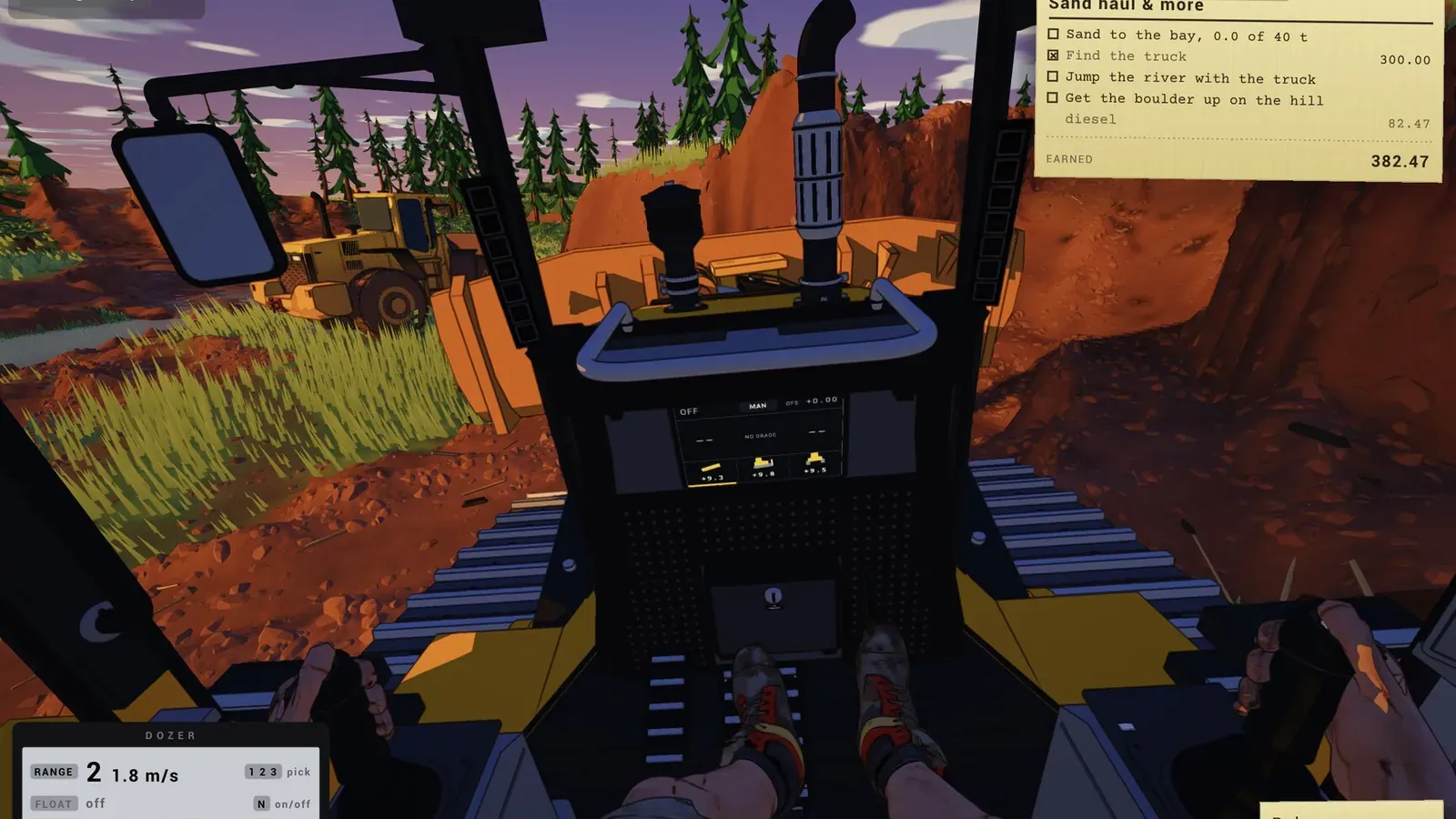
The grade you cut is a promise to the truck that has to climb it, so read the hauler guide→ before you commit to a slope.
| Control | Function | Default mistake |
|---|---|---|
| Float | Blade follows the ground, no cut | Leaving it on while you cut |
| Auto | Holds a set slope or curve | Fighting the sticks instead |
| Offset | Angles the blade in increments | Never using it, then wondering why the road puddles |
Ranges are 1.8 m/s in range 2 and 2.6 m/s in range 3, with range 1 for working. The speed is not the point — the point is that a dozer at full speed cannot hold a grade, and a dozer at working speed can.
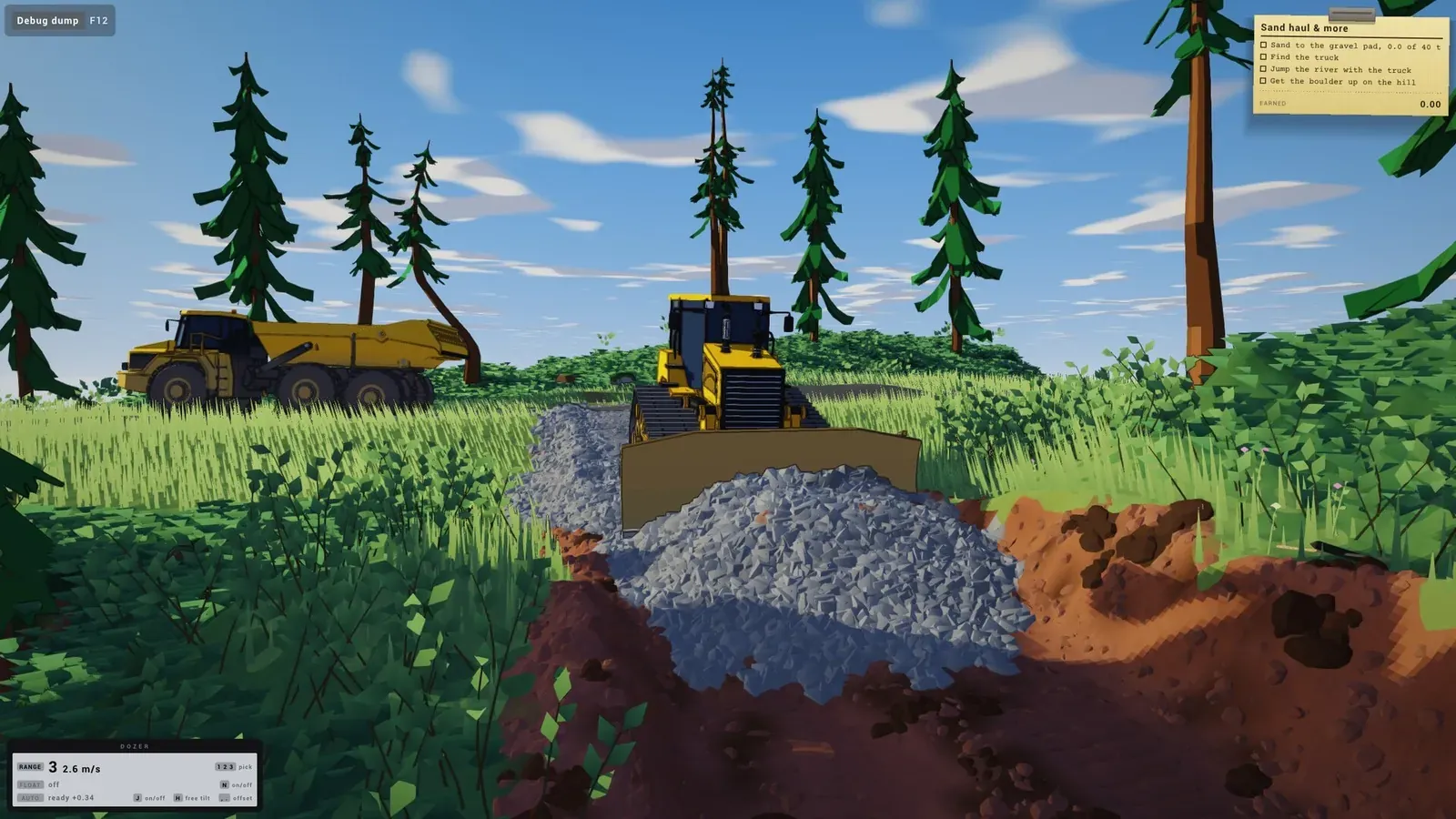
Step 1: cut in layers
A single deep blade pass through a slope creates a vertical face with nothing supporting it. The first rain, or the first loaded hauler, brings it down onto the road. Two or three shallow passes leave a face with a slope that holds.
Work from the top of the cut downward, and push the spoil to the outside of the bend rather than into the ditch. If you are cutting a notch, cut both sides so the road sits in the middle rather than against one wall.
Step 2: hold the grade with auto
Set the sticks where you want the slope to run, then let auto hold it. The value of auto is consistency: a road graded by hand has a wave in it, and a wave collects water at every low point.
Two things to watch while auto is working. First, the blade is holding an angle, not a height — if the ground under the tracks changes, the finished surface changes with it. Second, auto is for the long sections; release it for corners and for anything within a machine length of a drop.
Grade a climb in one direction and finish it in the same direction. Turning around mid-slope leaves a step that the hauler will find every lap.
Step 3: finish in float
Float lets the blade follow the surface you already cut, so it smooths rather than digs. This is the pass that turns a rough cut into a road: two or three float passes, blade loaded with loose material, working from the edges toward the centre.
Do not float a surface that has not been cut. Float on virgin ground just polishes the grass.
Step 4: cut the cross-fall with offset
A perfectly flat road holds water. A shallow cross-fall — a few degrees from the centre to one shoulder — sheds it. This is what blade offset is for: angle the blade slightly and take one pass along the road so the surface falls to the downhill side.
Do this after the grade is set, not before. A cross-fall cut into an ungraded surface produces a road that is both uneven and draining badly.
Working with the hauler
The dozer and the hauler are a pair: the dozer builds the climb, the hauler tests it. The test is simple — send the truck up loaded. If it spins, cut more off the grade rather than adding material, because a steeper ramp with better grip is still a ramp.
When a haul route fails repeatedly, the answer is usually one of three things: too steep, too loose, or too narrow. Fix them in that order. Width is the cheapest of the three, and it is the one people forget.
Pushing a loaded hauler with the blade is a last resort. It works once; do it every lap and you will burn the transmission out of the habit and lose the truck's tyres to the same ruts.
Official source: Dirt Town on Steam ↗ - store description, Early Access FAQ and machine list.
FAQ
What is the best range for dozing? Range 1 for cutting and grading, range 2 or 3 only for travelling. The blade needs slow, steady load to cut cleanly.
Should float be on when cutting? No. Float is a finishing control — it stops the blade from cutting, which is exactly wrong when you are trying to remove material.
Why does my graded road collect water? The surface is flat. Cut a shallow cross-fall with blade offset so water runs to the shoulder instead of sitting in the wheel ruts.
Can the dozer load a hauler? No. It can push material into a pile and spread it, but loading needs a wheel loader or an excavator.