
Dirt Town Beginner Guide: Your First Two Hours
A Dirt Town beginner guide to the first two hours: take the road mission, build access before you haul, and buy nothing until you know your bottleneck.
Start with the road mission, not the sand. In Dirt Town your first paid job is usually about creating access — clearing trees, pushing a track through, and getting the hauler somewhere it can climb. Do that first and every later delivery is faster; skip it and you spend the session winching a loaded truck out of a gully. The sequence below assumes the launch map and the starting wheel loader, hauler and dozer. If you want the wider reference first, the Dirt Town wiki→ holds the index.
- Build access before you haul. A route the hauler can climb is worth more than a faster bucket.
- Read the mission card. Objectives pay individually and diesel is deducted afterwards.
- Learn one machine properly before you spend on a second one.
Step 1: walk the site before you start an engine
Get out on foot and look at the ground you are about to work. The map is built from real terrain data, so the slopes are not decorative: a 15% grade that looks gentle from the cab will stop a loaded hauler dead. Walk the line from the resource to the drop-off, note where water sits, and find the shortest route that avoids a climb you cannot hold.
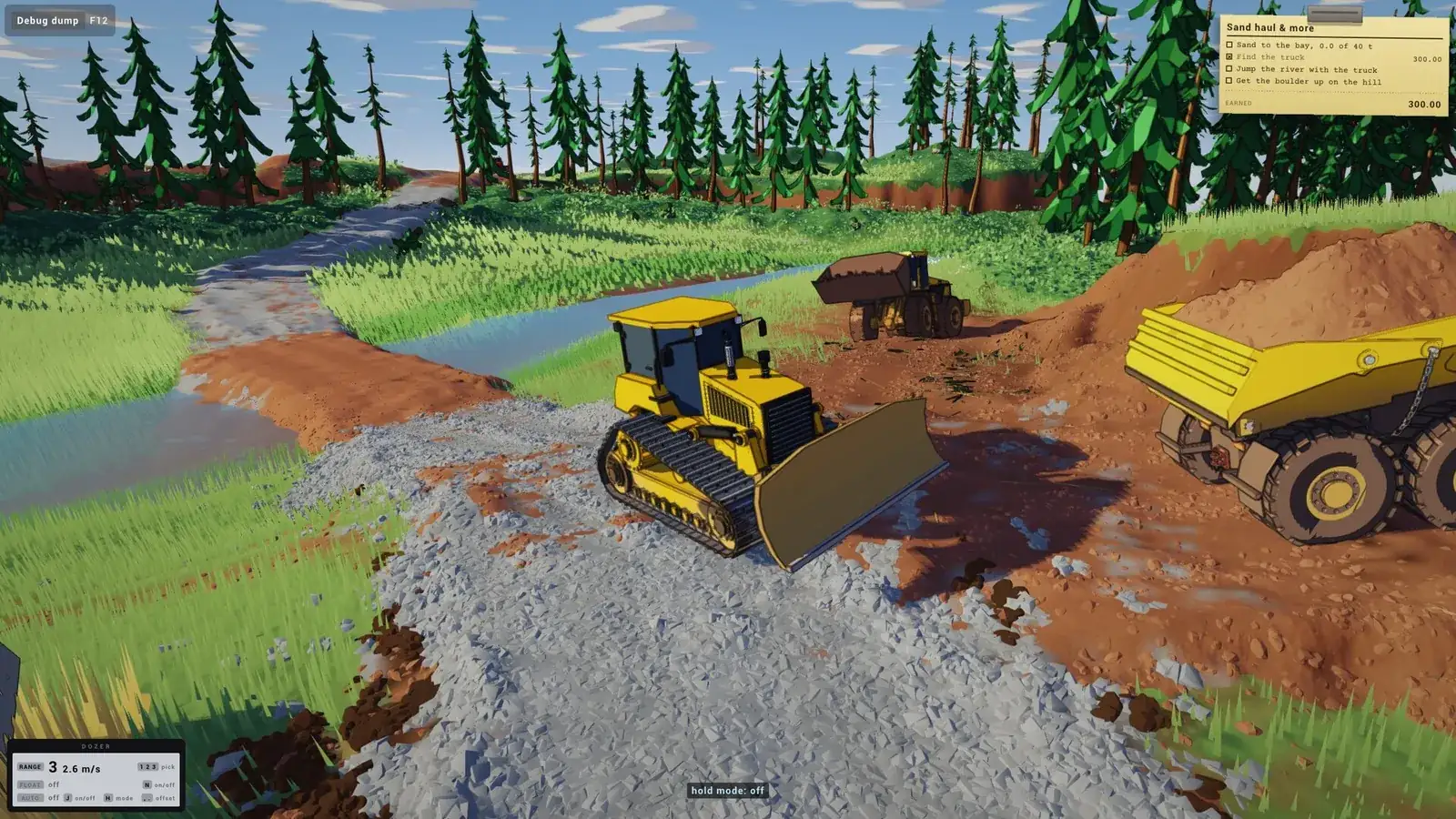
Two things are worth checking on that walk. First, whether the material is sand, clay or gravel — sand moves easily and holds nothing, clay holds a slope but turns to grease when it is wet. Second, where the trees are, because felling them is part of the job and the stumps stay in the ground until you deal with them.
Official source: Dirt Town store page ↗ — material layers, moisture and destructibility are described in the "Revolutionary simulation" section.
Step 2: cut the road with the dozer
Take the dozer to the worst part of your route first — the climb, the washed-out section, the treeline. Push in short passes with the blade low, and use auto-level rather than fighting the terrain by hand: set your sticks, let the blade hold grade, and only take manual control for the tight corners. Spread spoil to the downhill side so the road sits on fill rather than a thin shelf.
Do not chase a perfect surface. A rough but continuous road beats a beautiful 200 m section that ends in a cliff. The full method, including slopes and curves, is in the road building guide→; the cab-level controls are on the dozer page→.
Cutting a deep notch through a wet slope can start it sliding. If the ground is dark and soft underfoot, work in shallower layers and let it drain before you put weight on it.
Step 3: run one clean haul before you take a second mission
Load the hauler at the resource, drive the route you just built, tip, and come back empty once. That single round trip tells you three numbers you need: how long a load takes, how much diesel the run costs, and whether the hauler spins on any part of the climb. Only then accept a second mission — and prefer one that shares the same route.
Stacking missions on one road is the whole early game. A sand delivery and a gravel delivery that both end at the same pad cost you one road and one set of fuel runs. Two missions on opposite sides of the map cost you a road each.
Step 4: spend nothing until you know your bottleneck
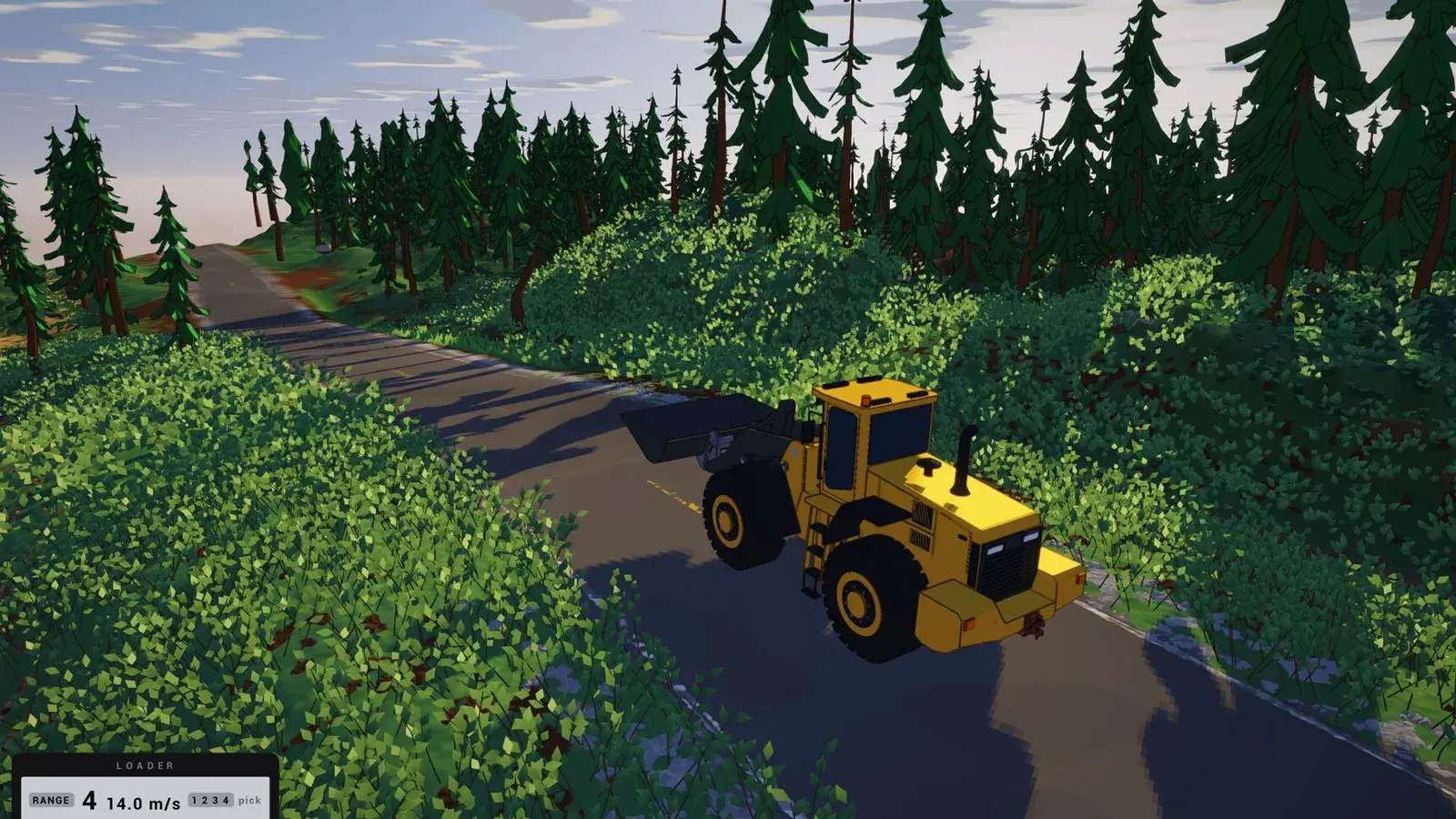
The shop will tempt you with a bigger machine long before you need one. Diagnose instead: if the hauler waits at the pile, your loader is the bottleneck; if the loader waits for a truck, it is the hauler; if both wait on the road, it is the road. Fixing a road is free apart from your time, which makes it the best value in the first hours.
The buying order with payback logic is on the best machines page→. The short version: an upgrade that removes a queue beats an upgrade that adds capacity you cannot feed.
Step 5: get comfortable with getting out
F presses you in and out of the cab, and on foot you can climb terrain and machines. That matters more than it sounds: hooking a chain, attaching a bucket, and reaching a machine that has tipped all require you to leave the seat. Backspace puts you upright if you fall. Practise the loop — out, walk to the attachment, hook it, climb back — on flat ground before you need it on a slope.
The complete key list per machine is in the controls reference→.
The first-hour checklist
- Walk the route on foot and pick the drop-off.
- Dozer the climb and the treeline; spread spoil downhill.
- One loaded round trip; note fuel and time.
- Accept a second mission that shares the road.
- Only then look at the shop.
FAQ
What should I do first in Dirt Town? Clear and grade access to the sand or gravel source. Without a usable road the hauler cannot contribute, and every mission after that is slower.
Should I sell resources or do missions? Missions first. They pay per objective and teach the map; resource shipping becomes the better steady income once your road and compaction are good.
How long is the tutorial? There is no scripted tutorial. The first mission or two act as one, and the demo is the cheapest way to learn the controls before launch.
Can I skip the dozer and just drive? You can, and you will spend the session recovering trucks. The dozer is the machine that makes the other three worth owning.